

Global take on finance and banking news
Provided by AGP
Philippines Data Center Market Share & Size | 2026-2034
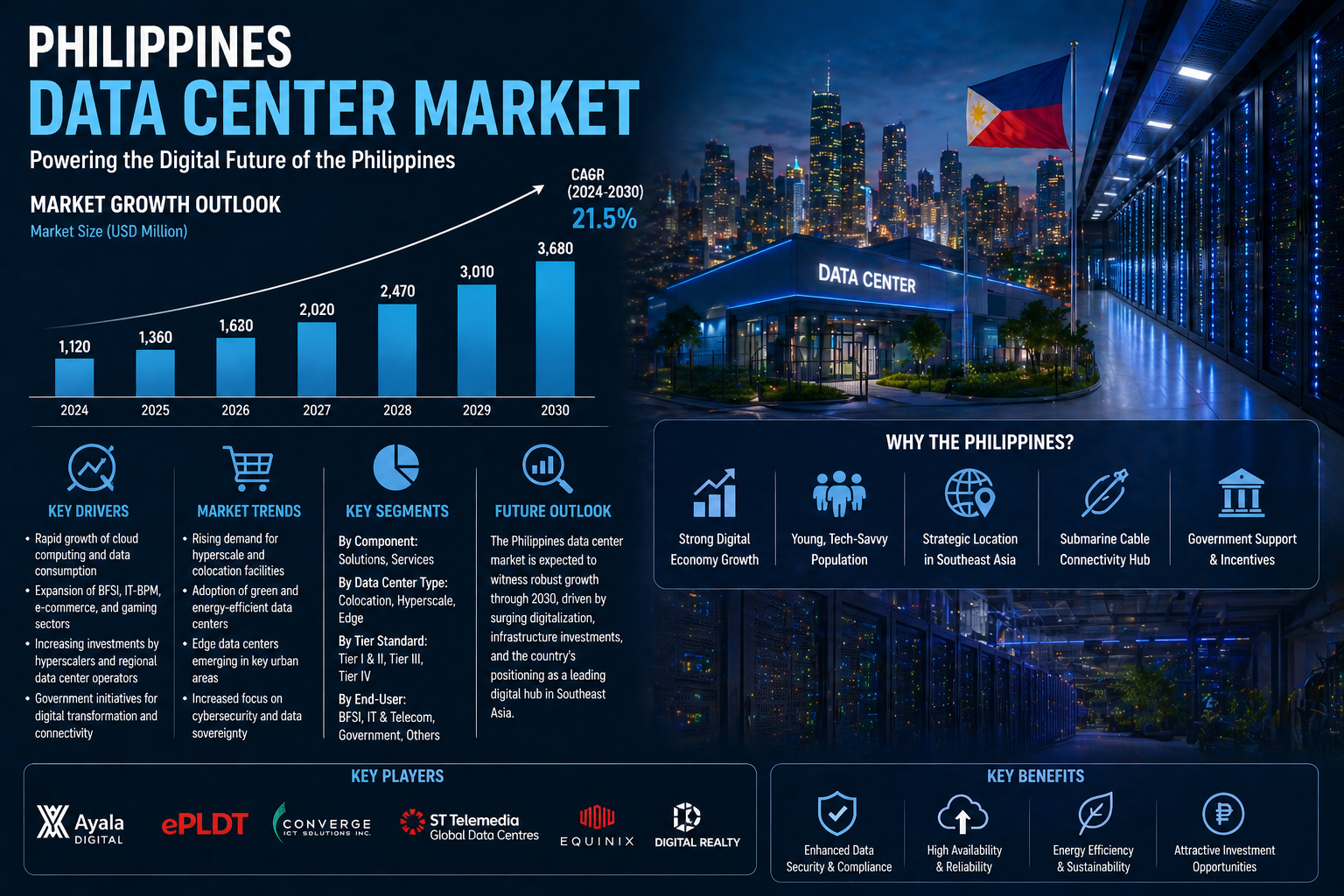
Philippines Data Center Market
Philippines data center market size reached USD 1,043.5 Million in 2025, is expected to reach USD 2,226.9 Million by 2034, CAGR of 8.61% during 2026-2034
PHILIPPINES, May 5, 2026 /EINPresswire.com/ -- 𝗣𝗵𝗶𝗹𝗶𝗽𝗽𝗶𝗻𝗲𝘀 𝗗𝗮𝘁𝗮 𝗖𝗲𝗻𝘁𝗲𝗿 𝗠𝗮𝗿𝗸𝗲𝘁 𝗢𝘃𝗲𝗿𝘃𝗶𝗲𝘄:The Philippines data center market reached 𝗨𝗦𝗗 𝟭,𝟬𝟰𝟯.𝟱 𝗠𝗶𝗹𝗹𝗶𝗼𝗻 in 2025 and is expected to reach 𝗨𝗦𝗗 𝟮,𝟮𝟮𝟲.𝟵 𝗠𝗶𝗹𝗹𝗶𝗼𝗻 by 2034, exhibiting a growth rate (𝗖𝗔𝗚𝗥) 𝗼𝗳 𝟴.𝟲𝟭% 𝗱𝘂𝗿𝗶𝗻𝗴 𝟮𝟬𝟮𝟲–𝟮𝟬𝟯𝟰. The market is experiencing rapid expansion driven by the surge in cloud adoption, AI workload demand, e-commerce growth, and the liberalization of foreign investment in telecom and data infrastructure. The Philippines currently has approximately 200 MW of operational data center capacity, with the DICT targeting 1.5 GW by the end of 2027 and an ambitious 18 GW within the next decade. Republic Act 11659, which opened data center ownership to 100% foreign equity, has unlocked a wave of international investment, with over 28 existing facilities and 13 upcoming projects transforming Metro Manila and emerging zones into a competitive ASEAN data center hub.
𝗪𝗵𝘆 𝗶𝘀 𝗛𝗼𝘁 𝗧𝗼𝗱𝗮𝘆 𝗣𝗵𝗶𝗹𝗶𝗽𝗽𝗶𝗻𝗲𝘀 𝗗𝗮𝘁𝗮 𝗖𝗲𝗻𝘁𝗲𝗿 𝗠𝗮𝗿𝗸𝗲𝘁?
The DICT outlined a massive 18 GW data center expansion plan in February 2026, positioning the Philippines to lead ASEAN in digital infrastructure and export computing capacity regionally; PLDT launched VITRO Sta. Rosa — the nation's first hyperscale data center built to handle AI workloads — with an aggregate 100 MW footprint; ENDECGROUP secured a 50-year lease for its USD 2.7 billion, 300 MW Narra Technology Park in New Clark City; Equinix completed its market entry by acquiring three TIM data centers in Makati and Cavite for approximately $180 million; the Konektadong Pinoy Act became law in August 2025, removing barriers to data transmission services; and major data center operators formed the Data Center Operators of the Philippines (DCPH) in November 2025 to address growing demand for hyperscale and AI infrastructure.
𝗣𝗵𝗶𝗹𝗶𝗽𝗽𝗶𝗻𝗲𝘀 𝗗𝗮𝘁𝗮 𝗖𝗲𝗻𝘁𝗲𝗿 𝗠𝗮𝗿𝗸𝗲𝘁 Summary:
Colocation is dominating the Philippines data center landscape, accounting for approximately 94.85% of the market, with retail colocation currently leading but wholesale colocation gaining rapid momentum as enterprises migrate workloads to cloud environments. The shift toward wholesale models is being driven by hyperscaler demand, with operators like ePLDT's VITRO network leading colocation capacity through 11 sites and 9,000 racks nationwide.
The Philippines is positioning itself as a competitive ASEAN data center hub, with construction costs averaging $6.5–$7.5 million per MW — significantly lower than Singapore, Thailand, and Indonesia — attracting global operators seeking cost-effective deployment locations combined with a skilled English-speaking workforce of over 1.5 million BPO professionals who support adjacent digital services demand.
Metro Manila remains the primary data center hub with approximately 20 active facilities, while emerging zones including Cavite, Quezon, and Clark are rapidly attracting large-footprint developments — exemplified by ENDECGROUP's USD 2.7 billion, 300 MW Narra Technology Park in New Clark City and PLDT's planned 100 MW facility in General Trias, Cavite — as operators seek land availability, power access, and lower operating costs beyond the congested capital region.
The DICT has outlined an ambitious 18 GW data center capacity expansion plan over the next decade, aiming to transform the Philippines from a regional participant into an ASEAN data center powerhouse capable of exporting computing capacity to neighboring countries and eventually to the Middle East and the United States — with near-term targets of reaching 1.5 GW of additional capacity by the end of 2027.
Republic Act 11659, which eliminated the 40% foreign ownership ceiling on telecom and data center assets, has unlocked a transformative wave of international investment — enabling global operators like Equinix, Alibaba Cloud, Digital Edge, and EdgeConneX to enter the Philippine market with full equity ownership, accelerating capital deployment, technology transfer, and operational expertise that is rapidly professionalizing the country's data center ecosystem.
The formation of the Data Center Operators of the Philippines (DCPH) in November 2025 — bringing together VITRO Inc., ST Telemedia Global Data Centres, Digital Edge Philippines, YCO Cloud, Digital Halo, and A-FLOW — represents a significant industry maturation milestone, with the alliance collectively managing nearly 500 MW of capacity and advocating for policy frameworks that support sustainable growth, renewable energy integration, and streamlined permitting processes.
Renewable energy integration is emerging as a strategic priority for Philippine data center operators, with First Gen Corporation negotiating to supply at least 180 MW of clean power to data center facilities and the government targeting 35% renewable energy in the national mix by 2030 — aligning data center development with sustainability mandates that are increasingly required by global hyperscalers and enterprise tenants selecting colocation partners based on environmental credentials.
Submarine cable connectivity is strengthening the Philippines' position as a data center destination, with the country connected to major submarine cable systems including APRICOT, SEA-H2X, and Bifrost, and Globe Telecom investing in the Mindanao Submarine Cable Project — expanding international bandwidth capacity that is essential for supporting cloud, AI, and content delivery workloads across the growing data center footprint.
𝗛𝗼𝘄 𝗔𝗜 𝗶𝘀 𝗥𝗲𝘀𝗵𝗮𝗽𝗶𝗻𝗴 𝘁𝗵𝗲 𝗣𝗵𝗶𝗹𝗶𝗽𝗽𝗶𝗻𝗲𝘀 𝗗𝗮𝘁𝗮 𝗖𝗲𝗻𝘁𝗲𝗿 𝗠𝗮𝗿𝗸𝗲𝘁:
Artificial intelligence is rapidly emerging as a transformative force across the Philippines data center market, fundamentally reshaping how facilities are designed, powered, cooled, and operated — driving a new generation of GPU-dense, AI-ready infrastructure that is critical to meeting the exploding demand for machine learning training, inference workloads, and cloud-native AI services as the Philippines positions itself as a competitive ASEAN hub for next-generation computing throughout the forecast period.
𝗥𝗲𝗾𝘂𝗲𝘀𝘁 𝗳𝗼𝗿 𝗮 𝘀𝗮𝗺𝗽𝗹𝗲 𝗿𝗲𝗽𝗼𝗿𝘁 𝗣𝗗𝗙: https://www.imarcgroup.com/philippines-data-center-market/requestsample
𝗠𝗮𝗿𝗸𝗲𝘁 𝗧𝗿𝗲𝗻𝗱𝘀 𝗮𝗻𝗱 𝗜𝗻𝘀𝗶𝗴𝗵𝘁𝘀:
The liberalization of foreign investment through Republic Act 11659 — which eliminated the 40% foreign equity ceiling on telecom and data center ownership — is acting as the foundational policy catalyst for the Philippines data center market, unlocking billions in international capital from global operators including Equinix (which acquired three TIM data centers for approximately $180 million), Alibaba Cloud, Digital Edge, and EdgeConneX, and transforming the competitive landscape from a domestically dominated market into an internationally contested ASEAN data center hub.
The explosive growth of the Philippines' digital economy — driven by rapidly expanding e-commerce, a 1.5 million-strong BPO workforce, fintech adoption, and government digitalization programs — is generating sustained and structurally growing demand for in-country data center capacity, with enterprises across BFSI, IT and telecom, and government sectors requiring low-latency, data-sovereign infrastructure to support cloud migration, digital payments processing, and customer-facing digital services for a population of over 115 million increasingly engaged in online commerce.
Hyperscale data center development is accelerating across the Philippines, with landmark projects including ENDECGROUP's USD 2.7 billion, 300 MW Narra Technology Park in New Clark City, PLDT's VITRO Sta. Rosa AI-ready facility with a 100 MW aggregate footprint, and ST Telemedia's $1 billion Fairview campus designed to become the country's largest data center at 124 MW — collectively representing a paradigm shift from small-scale enterprise facilities to globally competitive hyperscale infrastructure capable of serving international cloud and AI workloads.
The formation of the Data Center Operators of the Philippines (DCPH) in November 2025 marks a significant maturation of the industry ecosystem, with six founding members — VITRO, ST Telemedia GDC, Digital Edge, YCO Cloud, Digital Halo, and A-FLOW — collectively managing nearly 500 MW and establishing a unified industry voice that is engaging with government on power supply frameworks, renewable energy access, permitting streamlining, and the regulatory infrastructure needed to support the DICT's ambitious 18 GW capacity expansion roadmap.
Power supply and renewable energy integration are emerging as critical strategic challenges and opportunities for the Philippine data center market, with First Gen Corporation negotiating 180 MW of clean energy supply for data center clients, the government targeting 35% renewable energy in the national mix by 2030, and growing pressure from global hyperscalers — who increasingly mandate renewable-powered colocation — pushing operators to secure long-term clean power purchase agreements that align with international ESG standards and corporate sustainability commitments.
Geographic diversification beyond Metro Manila is reshaping the Philippines' data center footprint, with emerging development zones in Cavite (PLDT's 100 MW General Trias facility), Clark (ENDECGROUP's Narra Technology Park), Quezon, and Laguna (VITRO Sta. Rosa) attracting large-footprint builds that benefit from greater land availability, competitive power costs, reduced natural disaster exposure, and proximity to major submarine cable landing stations — creating a more resilient and geographically distributed national data center network.
𝗠𝗮𝗿𝗸𝗲𝘁 𝗚𝗿𝗼𝘄𝘁𝗵 𝗗𝗿𝗶𝘃𝗲𝗿𝘀:
𝗙𝗼𝗿𝗲𝗶𝗴𝗻 𝗜𝗻𝘃𝗲𝘀𝘁𝗺𝗲𝗻𝘁 𝗟𝗶𝗯𝗲𝗿𝗮𝗹𝗶𝘇𝗮𝘁𝗶𝗼𝗻, 𝗗𝗶𝗴𝗶𝘁𝗮𝗹 𝗘𝗰𝗼𝗻𝗼𝗺𝘆 𝗘𝘅𝗽𝗮𝗻𝘀𝗶𝗼𝗻, 𝗮𝗻𝗱 𝗖𝗹𝗼𝘂𝗱 𝗔𝗱𝗼𝗽𝘁𝗶𝗼𝗻
The Philippines data center market is primarily driven by the transformative impact of Republic Act 11659, which opened telecom and data center ownership to 100% foreign equity — eliminating the previous 40% ceiling and triggering a wave of international investment from Equinix, Alibaba Cloud, Digital Edge, and other global operators. This regulatory reform coincides with the rapid expansion of the Philippines' digital economy, powered by e-commerce growth, a 1.5 million-strong BPO workforce, fintech adoption, and government digitalization mandates. Cloud migration across BFSI, telecom, and government sectors is generating sustained demand for in-country colocation and managed services. The Konektadong Pinoy Act, which became law in August 2025, further supports this growth by removing barriers to data transmission services. Together, foreign capital liberalization, digital economy expansion, and accelerating cloud adoption are creating a powerful and self-reinforcing structural foundation for sustained market growth.
𝗛𝘆𝗽𝗲𝗿𝘀𝗰𝗮𝗹𝗲 𝗜𝗻𝗳𝗿𝗮𝘀𝘁𝗿𝘂𝗰𝘁𝘂𝗿𝗲 𝗗𝗲𝘃𝗲𝗹𝗼𝗽𝗺𝗲𝗻𝘁, 𝗔𝗜 𝗪𝗼𝗿𝗸𝗹𝗼𝗮𝗱 𝗗𝗲𝗺𝗮𝗻𝗱, 𝗮𝗻𝗱 𝗣𝗼𝘄𝗲𝗿 𝗜𝗻𝗳𝗿𝗮𝘀𝘁𝗿𝘂𝗰𝘁𝘂𝗿𝗲 𝗜𝗻𝘃𝗲𝘀𝘁𝗺𝗲𝗻𝘁
The Philippines is witnessing an unprecedented wave of hyperscale data center construction, with transformative projects including ENDECGROUP's USD 2.7 billion, 300 MW Narra Technology Park in New Clark City, PLDT's VITRO Sta. Rosa AI-ready hyperscale facility, and ST Telemedia's $1 billion, 124 MW Fairview campus. These developments are being driven by the surging demand for AI workloads — with modern GPU racks requiring 100–140 kW compared to traditional 5–10 kW deployments — compelling operators to invest in advanced liquid cooling, high-density power distribution, and AI-optimized facility design. Power infrastructure is simultaneously scaling, with First Gen Corporation negotiating 180 MW of clean energy supply and the government targeting 35% renewable energy by 2030. The DICT's ambitious vision of 18 GW national capacity over the next decade reflects the scale of infrastructure transformation underway.
𝗚𝗲𝗼𝗴𝗿𝗮𝗽𝗵𝗶𝗰 𝗗𝗶𝘃𝗲𝗿𝘀𝗶𝗳𝗶𝗰𝗮𝘁𝗶𝗼𝗻, 𝗖𝗼𝗻𝗻𝗲𝗰𝘁𝗶𝘃𝗶𝘁𝘆, 𝗮𝗻𝗱 𝗜𝗻𝗱𝘂𝘀𝘁𝗿𝘆 𝗠𝗮𝘁𝘂𝗿𝗮𝘁𝗶𝗼𝗻
The Philippines data center market is maturing through geographic diversification, connectivity expansion, and industry ecosystem development. While Metro Manila remains the primary hub with approximately 20 active facilities, emerging zones in Cavite, Clark, Quezon, and Laguna are attracting multi-hundred-megawatt developments that offer superior land availability, competitive power costs, and reduced congestion risk. Submarine cable connectivity is strengthening through systems like APRICOT, SEA-H2X, and Bifrost, complemented by Globe Telecom's Mindanao Submarine Cable Project. The formation of the DCPH alliance in November 2025 — with six founding operators managing nearly 500 MW — signals a new era of industry collaboration, policy advocacy, and operational standardization. These geographic, connectivity, and institutional advances are positioning the Philippines as a credible alternative to established ASEAN data center markets and supporting the country's ambition to become a regional digital infrastructure exporter.
𝗠𝗮𝗿𝗸𝗲𝘁 𝗦𝗲𝗴𝗺𝗲𝗻𝘁𝗮𝘁𝗶𝗼𝗻:
IMARC Group's research categorizes the Philippines data center market as follows:
𝗕𝘆 𝗖𝗼𝗺𝗽𝗼𝗻𝗲𝗻𝘁:
Solution
Services
𝗕𝘆 𝗗𝗮𝘁𝗮 𝗖𝗲𝗻𝘁𝗲𝗿 𝗧𝘆𝗽𝗲:
Colocation
Hyperscale
Edge
Others
𝗕𝘆 𝗘𝗻𝘁𝗲𝗿𝗽𝗿𝗶𝘀𝗲 𝗦𝗶𝘇𝗲:
Large Enterprises
Small and Medium-sized Enterprises
𝗕𝘆 𝗘𝗻𝗱 𝗨𝘀𝗲𝗿:
BFSI
IT and Telecom
Government
Energy and Utilities
Others
𝗕𝘆 𝗥𝗲𝗴𝗶𝗼𝗻:
Luzon
Visayas
Mindanao
𝗞𝗲𝘆 𝗣𝗹𝗮𝘆𝗲𝗿𝘀:
The competitive landscape of the Philippines data center market includes a comprehensive analysis of key player positioning, market structure, top winning strategies, competitive dashboards, and company evaluation quadrants. Some of the key players operating in the market include Alibaba Cloud, Digital Edge (Singapore) Holdings Pte. Ltd, EdgeConneX Inc, Equinix Inc., Space DC Pte Ltd., and VITRO Inc. Detailed profiles of all major companies are provided within the full IMARC Group research report.
𝗥𝗲𝗰𝗲𝗻𝘁 𝗡𝗲𝘄𝘀 𝗮𝗻𝗱 𝗗𝗲𝘃𝗲𝗹𝗼𝗽𝗺𝗲𝗻𝘁𝘀:
𝗙𝗲𝗯𝗿𝘂𝗮𝗿𝘆 𝟮𝟬𝟮𝟲: The Department of Information and Communications Technology (DICT) outlined a massive 18 GW data center capacity expansion plan over the next decade, positioning the Philippines to lead ASEAN in digital infrastructure. ICT Secretary Henry Rhoel R. Aguda announced plans to export computing capacity to ASEAN countries and eventually to the Middle East and the United States.
𝗡𝗼𝘃𝗲𝗺𝗯𝗲𝗿 𝟮𝟬𝟮𝟱: Major data center operators formed the Data Center Operators of the Philippines (DCPH), bringing together VITRO Inc., ST Telemedia Global Data Centres, Digital Edge Philippines, YCO Cloud, Digital Halo, and A-FLOW — collectively managing nearly 500 MW of capacity and establishing a unified industry alliance to advocate for policy frameworks supporting sustainable growth and streamlined permitting.
𝗔𝘂𝗴𝘂𝘀𝘁 𝟮𝟬𝟮𝟱: The Konektadong Pinoy Act became law, recognizing access to digital services as essential to participation in the global economy and removing barriers to entry for new participants in data transmission services — further supporting data center development and digital infrastructure investment.
𝗝𝘂𝗹𝘆 𝟮𝟬𝟮𝟱: Alibaba Cloud announced plans to open its second data center region and cloud availability zone in the Philippines, enhancing cloud capacity and AI service support for the country's rapidly digitalizing enterprise and government sectors.
𝗝𝘂𝗻𝗲 𝟮𝟬𝟮𝟱: Equinix completed the acquisition of three carrier-neutral data center facilities from Total Information Management (TIM) in Makati and Cavite for approximately $180 million — marking the company's official entry into the Philippine market and bringing world-class interconnection and colocation services to Manila.
𝗠𝗮𝘆 𝟮𝟬𝟮𝟱: ENDECGROUP secured a 50-year lease for its USD 2.7 billion, 300 MW Narra Technology Park in New Clark City, with operations expected to commence in Q4 2026 — one of the largest data center investments in Philippine history and a landmark project for the Bases Conversion and Development Authority's technology hub strategy.
𝗠𝗮𝘆 𝟮𝟬𝟮𝟱: First Gen Corporation began negotiations to supply at least 180 MW of clean power to data center operators, expanding from its current 17.4 MW of data center energy supply — signaling the growing convergence of renewable energy development and data center infrastructure in the Philippines.
𝗔𝗽𝗿𝗶𝗹 𝟮𝟬𝟮𝟱: PLDT officially launched VITRO Sta. Rosa, the nation's first hyperscale data center built specifically to handle AI and GPU workloads, with PLDT Chairman Manuel V. Pangilinan announcing ambitions to expand total data center capacity to 500 MW through a new facility in General Trias, Cavite, with construction beginning in 2026.
𝗡𝗼𝘁𝗲: 𝗜𝗳 𝘆𝗼𝘂 𝗿𝗲𝗾𝘂𝗶𝗿𝗲 𝗮𝗻𝘆 𝘀𝗽𝗲𝗰𝗶𝗳𝗶𝗰 𝗶𝗻𝗳𝗼𝗿𝗺𝗮𝘁𝗶𝗼𝗻 𝘁𝗵𝗮𝘁 𝗶𝘀 𝗻𝗼𝘁 𝗰𝗼𝘃𝗲𝗿𝗲𝗱 𝗰𝘂𝗿𝗿𝗲𝗻𝘁𝗹𝘆 𝘄𝗶𝘁𝗵𝗶𝗻 𝘁𝗵𝗲 𝘀𝗰𝗼𝗽𝗲 𝗼𝗳 𝘁𝗵𝗲 𝗿𝗲𝗽𝗼𝗿𝘁, 𝘄𝗲 𝘄𝗶𝗹𝗹 𝗽𝗿𝗼𝘃𝗶𝗱𝗲 𝘁𝗵𝗲 𝘀𝗮𝗺𝗲 𝗮𝘀 𝗮 𝗽𝗮𝗿𝘁 𝗼𝗳 𝘁𝗵𝗲 𝗰𝘂𝘀𝘁𝗼𝗺𝗶𝘇𝗮𝘁𝗶𝗼𝗻.
𝗕𝗿𝗼𝘄𝘀𝗲 𝘁𝗵𝗲 𝗳𝘂𝗹𝗹 𝗿𝗲𝗽𝗼𝗿𝘁 𝘄𝗶𝘁𝗵 𝗧𝗢𝗖 𝗮𝗻𝗱 𝗹𝗶𝘀𝘁 𝗼𝗳 𝗳𝗶𝗴𝘂𝗿𝗲𝘀: https://www.imarcgroup.com/philippines-data-center-market
Other Reports by IMARC Group:
Philippines Eyewear Market 2026: https://www.imarcgroup.com/philippines-eyewear-market
Philippines Retail Market 2026: https://www.imarcgroup.com/philippines-retail-market
Philippines VAPE Market 2026: https://www.imarcgroup.com/philippines-vape-market
Philippines Lingerie Market 2026: https://www.imarcgroup.com/philippines-lingerie-market
Philippines Home Decor Market 2026: https://www.imarcgroup.com/philippines-home-decor-market
Elena Anderson
IMARC Services Private Limited
+1 201-971-6302
email us here
Legal Disclaimer:
EIN Presswire provides this news content "as is" without warranty of any kind. We do not accept any responsibility or liability for the accuracy, content, images, videos, licenses, completeness, legality, or reliability of the information contained in this article. If you have any complaints or copyright issues related to this article, kindly contact the author above.
